Not to Repeat, But to Remember
There is a painting I first encountered in high school, long before I really understood what classical and even fine art was. St. John the Baptist, by Da Vinci. I did not know much about its history, I only knew I could not stop looking at it. A figure emerging from darkness, a smile that meant nothing definite, light that seemed deliberately withheld.
From there I began following the rest of Da Vinci's work. That path, sooner or later, always led to Mona Lisa.
Back then I was still far more familiar with manga and anime than with Renaissance painting. I was part of the Japanese Club at school, and because I was known as someone who could draw, I was chosen to present a piece to the new students. I was supposed to bring something related to manga. I brought Mona Lisa instead, an A3 replica I had worked on fairly seriously for a high school student.
The piece never made it to the stage. That day's demo turned out to be all live cosplay, there was no space left to display a drawing. I was disappointed for a moment, though it did not linger, the atmosphere was simply never built for that kind of showing.
I only understood later that this small moment marked something much larger. I was in the middle of an extreme transition, from manga toward traditional realism, portraiture, replicas of Renaissance works. And that is exactly where I feel I took a wrong step. Classical realism should have been the most fundamental ground I learned first, before I ever encountered manga. I reversed that order without realizing it, and because of that I struggled quite a lot during those years. Things that should have been my starting foundation only caught up with me later, the hard way.
I copied Mona Lisa many times back then, I lost count. I never archived those old pieces properly, which I regret. I never imagined this process would grow into what it is now. I was just a kid who felt he had some talent for drawing, with no idea where to channel it, especially since that ability was never given much appreciation at home growing up.
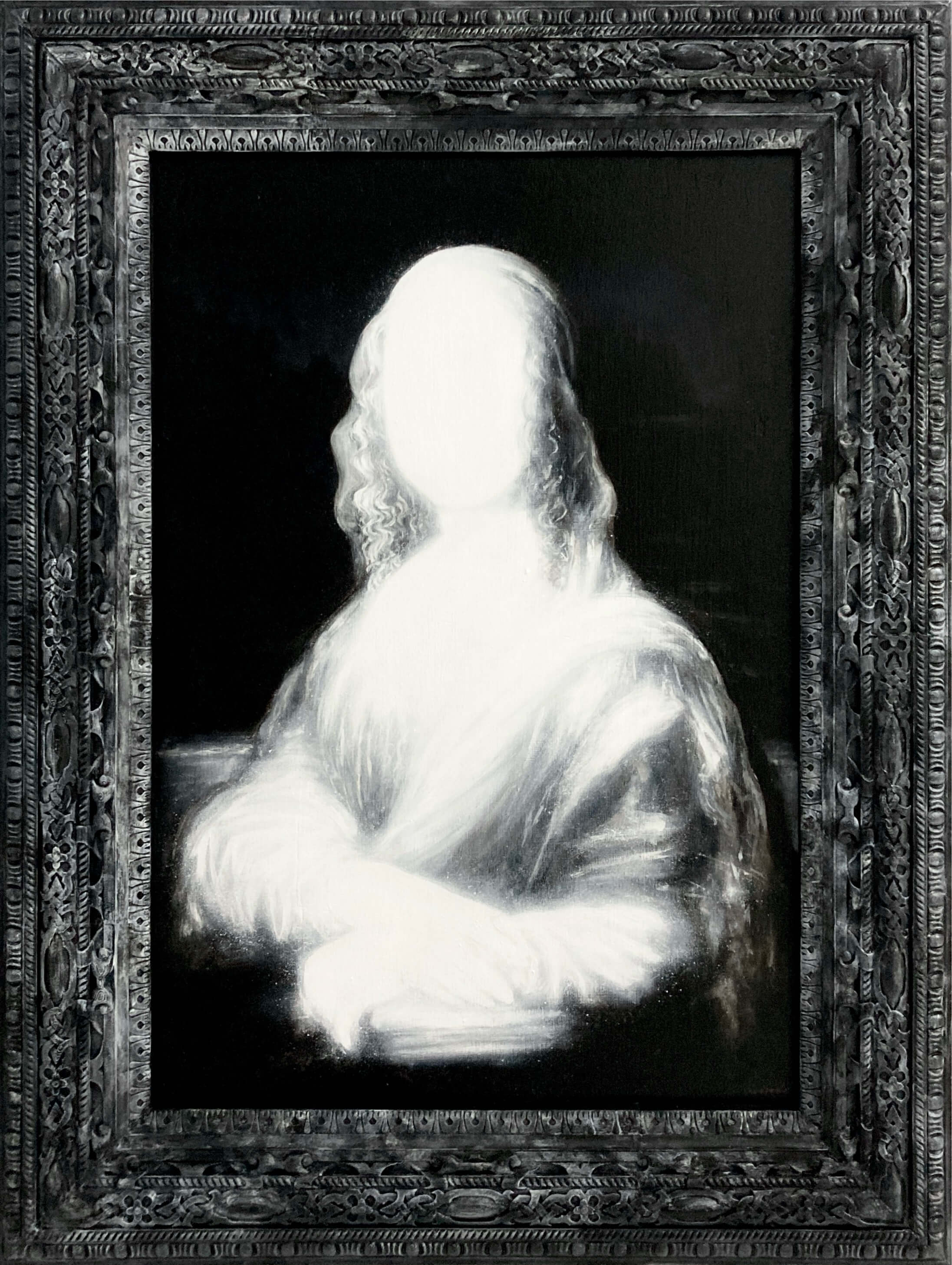
Years later, when I finished “Mona Lisa (revaleka's Copy, VERSO),” a flashback arrived in an instant. The high school kid who once copied fading faces from art books, without critical distance, only with full admiration, suddenly felt close again.
This piece belongs to the sixth album in my discography, Canon Appropriations, a personal retrospective revisiting the early phases of my interest in fine art. In this version, I render Mona Lisa through overexposure, a lighting approach that washes out much of the figure's facial detail while sharpening its presence as an icon that feels familiar yet distant. The VERSO version refers to the black and white variant of this piece, a visual intervention that restages its atmosphere. Like a memory blurring at the edges, losing its color, yet still holding onto a deep affective intensity.
Canon Appropriations was conceptually framed and projected by me for 2025. But the first piece from this album actually appeared a year earlier. “Salvator Mundi (Revaleka's Copy)” arrived in 2024. “Mona Lisa (revaleka's Copy, VERSO)” became the second piece from the album that I presented, right on its intended year, 2025. It is something of a tendency of mine, planting the flag early before an album officially begins.
Mona Lisa actually exists in two versions, RECTO and VERSO. RECTO I am still holding onto, waiting for the right time.
Returning to Mona Lisa through this piece is not about repeating what I made in high school, but about remembering it. I see it now with a far more mature perspective. Its original resonance, the admiration of a teenager who had just found a new world by taking the wrong turn into it, is still there.